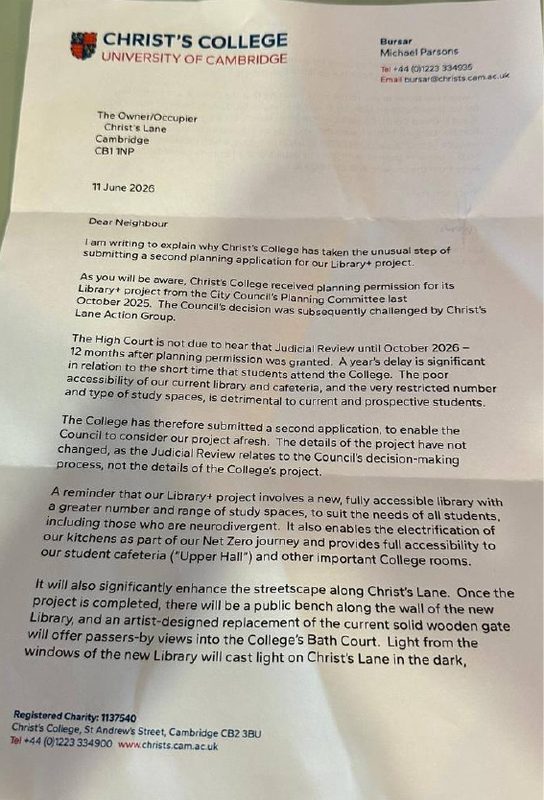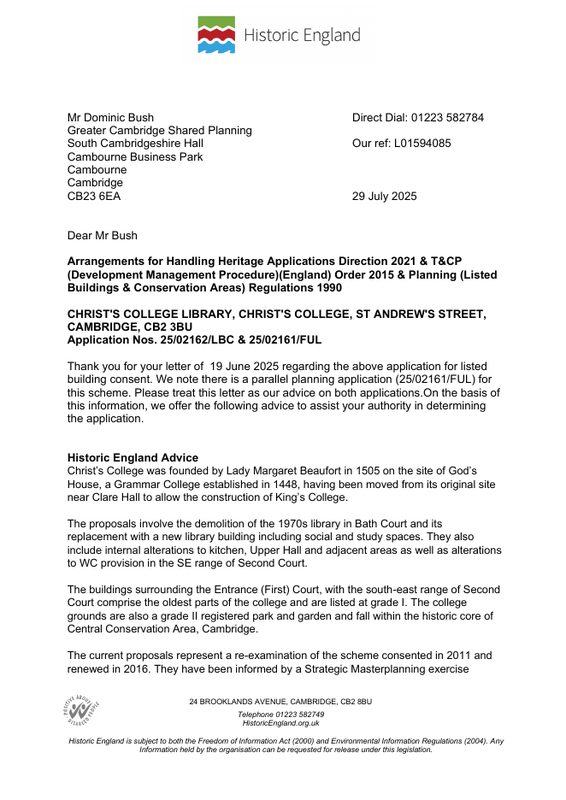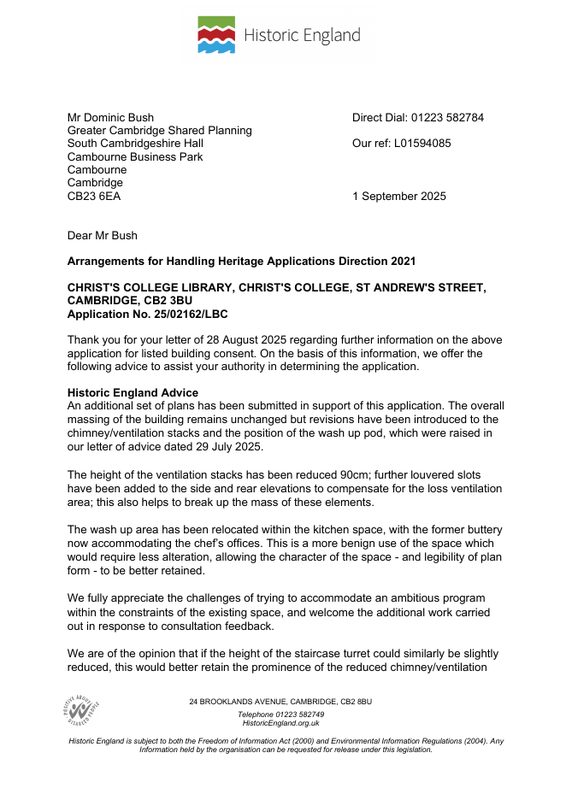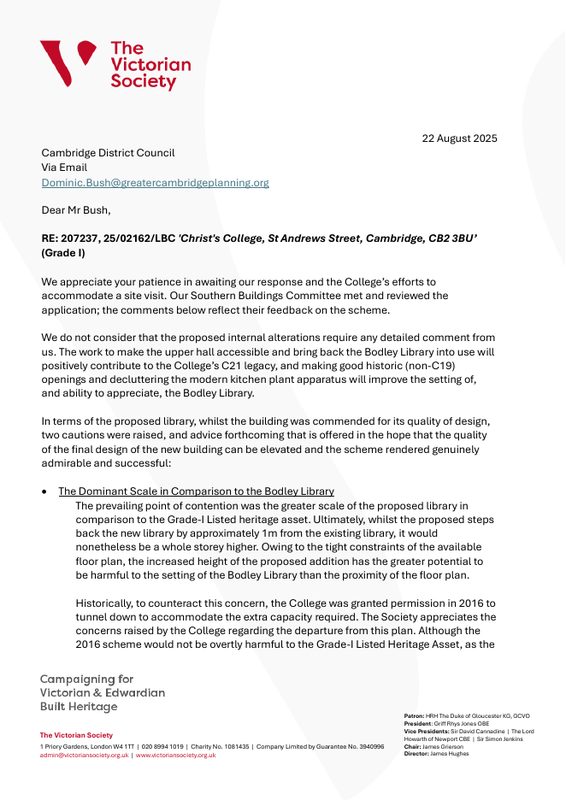

The Bursar’s email to councillors, 11 June 2026
“The details of the project have not changed, as the Judicial Review relates to the Council’s decision-making process, not the details of the College’s project.”
The Bursar, Christ’s College Cambridge, in an email to all 42 Cambridge City Councillors, 11 June 2026.
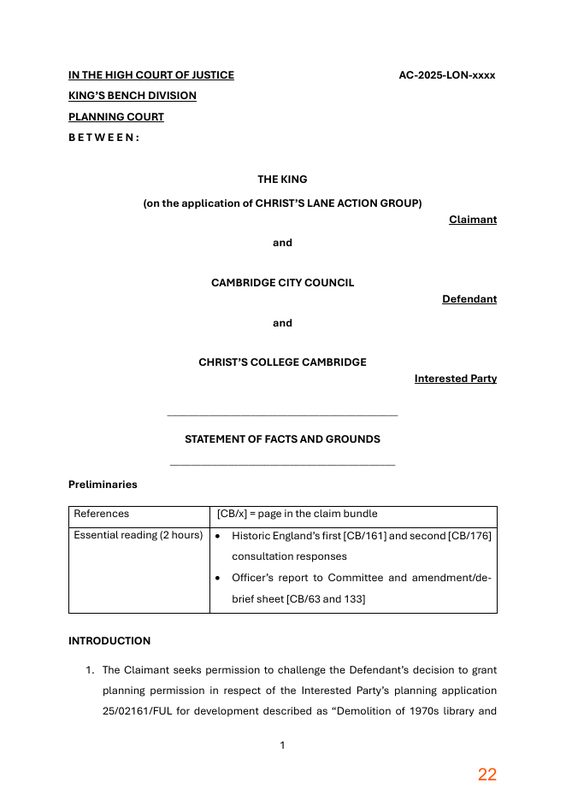
The four grounds of challenge
The Statement of Facts and Grounds stated that the planning committee’s decision was legally flawed “in the way it dealt with heritage matters” and that the statutory duty under section 66(1) of the Planning (Listed Buildings and Conservation Areas) Act 1990 was not lawfully discharged. The four grounds (paragraph 6) alleged, in summary:
- Ground 1The committee was materially misled about Historic England’s advice: Historic England had identified harm from the bulk and overall massing of the proposal, that massing remained “unchanged” after amendments, and that finding was omitted from the officer’s report.
- Ground 2The committee received inconsistent advice on whether there was less than substantial harm requiring a public-benefits balance under NPPF paragraph 215, or a neutral impact meaning no harm. The report did both simultaneously, risking dilution of the mandatory weight to be given to harm.
- Ground 3The committee was advised that the scheme would help to secure the listed building’s “optimum viable use” as a public benefit. That was based on flawed logic and was unsupported by evidence: the college has been in continuous educational use for over 500 years.
- Ground 4Where harm to a listed building’s setting is identified, consideration of less harmful alternatives is a material consideration. The committee was not advised of this, even though alternatives existed.
Those are legal grounds. But they are legal grounds about heritage harm, massing, the officer’s summary of Historic England’s advice, the public-benefits balance, and whether a less harmful design should have been considered, all matters inseparable from the details of the proposed building.
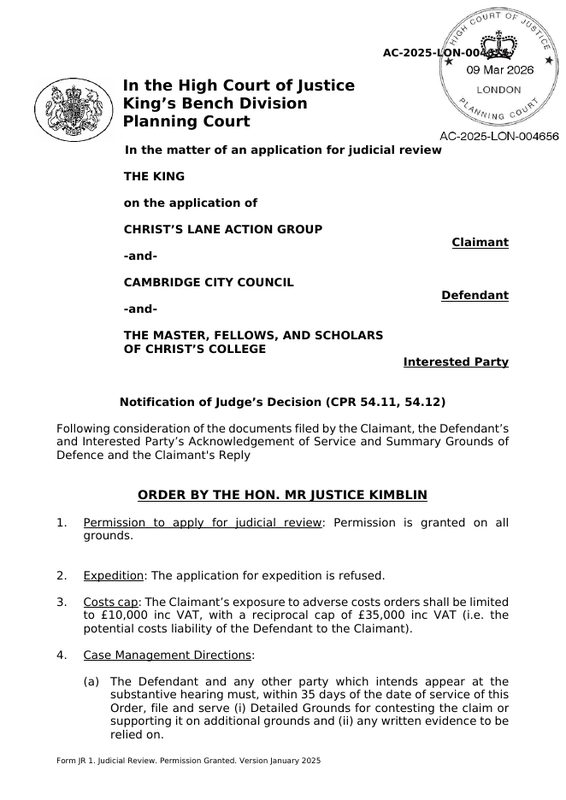
Mr Justice Kimblin granted permission on all grounds
“Permission to apply for judicial review: Permission is granted on all grounds.”Order by Mr Justice Kimblin, 6 March 2026 (served 9 March 2026).
“The Claimant raises important issues about the decision making in this case which had a bearing on key planning considerations which informed the grant of consent. I consider that they are strongly arguable and merit consideration at a full hearing.”Mr Justice Kimblin, Observations and Reasons, 6 March 2026.
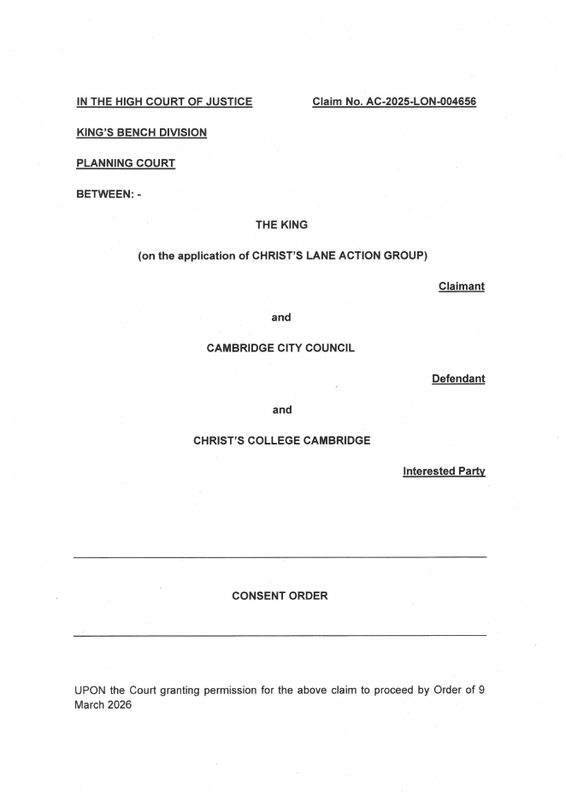
Cambridge City Council and Christ’s College then agreed, by consent order, that the permission could be quashed on all four grounds
“The Defendant and Interested Party have agreed to a Consent Order quashing the Council’s decision on all four grounds, with a supporting Statement.”Cambridge City Council letter to the Administrative Court, 28 April 2026, para 6.
“The position is not materially different from if the Defendant and Interested Party had conceded the claim on all grounds in its Acknowledgement of Service.”Cambridge City Council letter to the Administrative Court, 28 April 2026, para 12.
The statement is accurate in the narrow sense that judicial review tests legal error, not architectural merit. But the four grounds pleaded in the Statement of Facts and Grounds, quoted above, all turn on the heritage assessment of the building’s design. In CLAG’s view, “not the details of the College’s project” should be read alongside those grounds, which concern the building directly.