
The Second Application
The Secretary of State’s direction, 13 October 2026
PDF · 2 pages · Primary source · Published on the Council’s register on 14 October 2026 · Page written 16 October 2026
On Tuesday 13 October 2026 the Secretary of State for Housing, Communities and Local Government directed Cambridge City Council not to grant permission on application 26/02109/FUL without her specific authorisation, while she considers whether to call the application in. The direction is on the Council’s public planning register as document 9554694. The Planning Casework Unit has told the group that it has no end date.
Download the direction (PDF) Back to News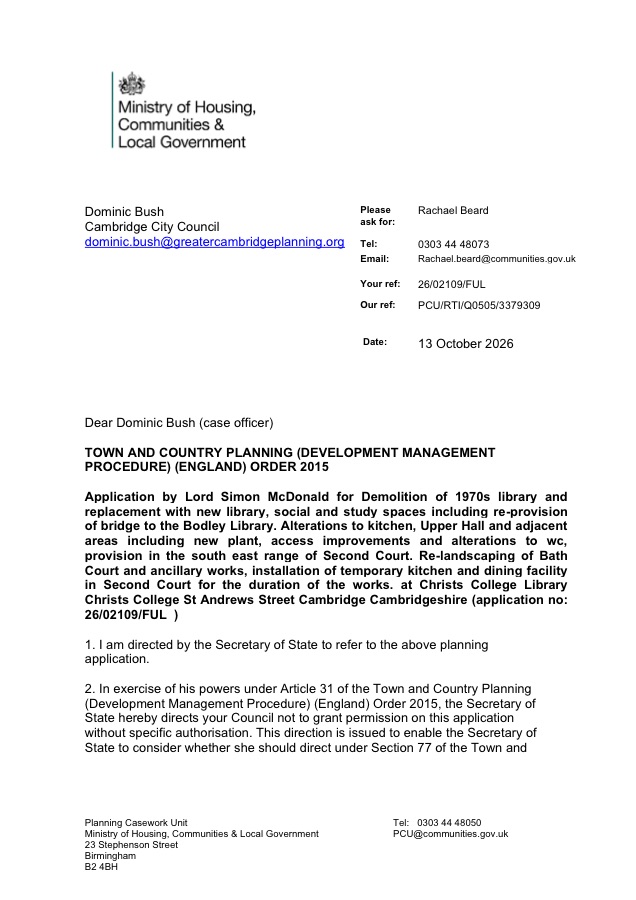
The direction and what it says
What happened on Tuesday 13 October 2026
At 9.22 am the group emailed the Planning Casework Unit of the Ministry of Housing, Communities and Local Government. It asked the Secretary of State to give a direction under article 31 of the Town and Country Planning (Development Management Procedure) (England) Order 2015 restricting Cambridge City Council from granting permission on application 26/02109/FUL, and to call the application in. The Council’s Joint Director of Planning and its Legal Practice were copied.
The same day Daniel Zeichner, Member of Parliament for Cambridge, wrote to the Secretary of State forwarding the group’s submission.
At 8.37 pm the Unit replied to the group. Its letter says that “an Article 31 Direction under the Town and Country Planning (General Development Procedure) (England) Order 2015 was issued by the Planning Casework Unit on 13 October, the effect of which prevents the Council from granting planning permission without special authorisation”. The letter adds that the application “will be considered in due course and your views, along with all other relevant information, will be taken into account before the Secretary of State decides whether or not to call-in the application for determination”.
The direction
The direction is a letter of 13 October 2026 from the Unit to the Council’s case officer, reference PCU/RTI/Q0505/3379309. The Council published it on the planning register on 14 October 2026 as document 9554694, under the title “SECRETARY OF STATE 31 LETTER”. Its paragraphs read as follows.
“1. I am directed by the Secretary of State to refer to the above planning application.”
“2. In exercise of his powers under Article 31 of the Town and Country Planning (Development Management Procedure) (England) Order 2015, the Secretary of State hereby directs your Council not to grant permission on this application without specific authorisation. This direction is issued to enable the Secretary of State to consider whether she should direct under Section 77 of the Town and Country Planning Act 1990 that the application should be referred to her for determination.”
“3. This direction does not, of course, prevent your Council from considering the application, forming a view as to the merits or, if they are so minded, refusing permission.”
“4. This letter is for procedural purposes and should not be read as any indication of the Secretary of State’s attitude towards the application scheme.”
“5. I would be grateful for acknowledgement of your receipt of this letter. Please contact the case officer if you have any queries.”
The letter is signed by the Senior Planning Casework Manager of the Planning Casework Unit. It states no period. The Unit’s letter to the group names the Order as the General Development Procedure Order. The direction itself names the Development Management Procedure Order 2015.
The Council’s acknowledgement
The Unit emailed the direction to the Council’s case officer at 8.30 pm on 13 October. The case officer replied at 9.24 am on Wednesday 14 October: “I can confirm receipt of the attached Article 31 Letter.” The exchange was uploaded to the register at 10.35 am that morning as document 9554677, under the title “OFFICER ACKNOWLEDGEMENT OF ARTICLE 31 LETTER”.
What the Planning Casework Unit told the group on 14 October
The group wrote to the Unit early on 14 October asking for confirmation of what the direction covers and for a copy of it. The Unit replied at 10.51 am. It wrote that “We are assessing the application against published policy on calling in applications.” It wrote that a decision on whether or not to call in an application “is a procedural decision as to who should deal with a planning application”. It wrote that the direction “has no end date” and “remains in effect until such time as a decision is made on whether to call in the 2026 application”.
What the direction does, in its own words
The Council may not grant permission on the application without the Secretary of State’s specific authorisation. The Council may still consider the application, form a view on its merits and refuse it. The letter is procedural and gives no indication of the Secretary of State’s view of the scheme. If the Secretary of State calls the application in, she decides it. If she does not, the direction ends with that decision.
What the Council and the College said
Cambridge City Council gave the press a statement on 14 October. It said: “This stage of the process does not involve consideration of the planning merits of the proposal. Rather, it is a procedural step to determine whether the application should be decided locally by the council or by the secretary of state.” It said: “The council awaits confirmation of the secretary of state’s position.”
Christ’s College told the press that the intervention was “extremely disappointing”. It said: “This is the second time that councillors have voted to approve the project.”
Building Design reported that “The council had been due to issue its official approval for the newer application on Friday 16 October.” The planning register gives Friday 16 October 2026 as the agreed expiry date for the decision.
The group’s statement
On the record, from Christ’s Lane Action Group: “It should not take a Secretary of State to make Cambridge City Council wait for the High Court. The Council has already conceded that its first permission was unlawful on all four grounds. Thirteen days before the Court rules on those errors, members approved the identical scheme again, because they were told they could not wait. Whitehall says they can. We do not oppose a new library for Christ’s College, but this scheme is too big for its location, as Historic England has warned. The Council repeated its errors in committee, then tried to outrun the Court before judgment.”
The documents
- The direction, 13 October 2026 (PDF, register document 9554694)
- The Council’s acknowledgement, 14 October 2026 (PDF, register document 9554677)
- The Planning Casework Unit’s letter to the group, 13 October 2026 (PDF)
- The documents tab of the planning register for 26/02109/FUL
- The Planning Committee of 7 October 2026: the record
- The Architects’ Journal, 14 October 2026: “Rayner intervenes to halt Grafton’s controversial Cambridge library”
- Building Design, 14 October 2026: “Rayner freezes consent for Grafton’s Cambridge library six days before scheme heads to High Court”
- Cambridge Independent, 14 October 2026: “Christ’s College library plans halted while secretary of state considers call‑in”
The direction is reproduced from the PDF published on the Council’s register. The address block and telephone numbers at the head of the letter are omitted here and are in the PDF. The Unit’s letters to the group are quoted from the originals held by the group.
Open the direction (PDF)The first permission is quashed. The second is frozen.
On Tuesday 20 October 2026 the High Court quashed the first approval, 25/02161/FUL, on all four grounds of our claim. The Secretary of State has frozen the permission. On 13 October she directed the Council not to grant it without her authorisation while she considers whether to call the application in, six days after the identical application 26/02109/FUL was controversially approved. If you would like to support a call in, write to us and we will tell you how.
Email residents@christs-lane.com.