

Christ’s Lane Action Group (CLAG)
The campaign, date by date
The saga of Christ’s College Library+ Scheme, chronicled beat by beat. The College resubmits the identical building after it concedes to quashing on all four judicial review grounds, as though none of it happened. And now the latest twists: the Council blocks every email we send to councillors; our evidence appears on the public register backdated; the College and the Council write to the High Court behind our backs to try to vacate our hearing, and the judge refuses; and the officers’ report puts none of it before the committee that votes on 7 October. Every twist and turn is chronicled here, each entry linked to the primary document or the coverage. And take a light read of CLAG’s newsletters, uploaded as they are published.
Newest first
October 2026
- Alec Forshaw: “No document on the register states a fire requirement for the height of the tower, and no regulation imposes one”Last year’s report said the applicant had “chosen to retain” the height of the stair tower. This year’s says it “provides a form of fire escape” and “therefore has a minimum height requirement”. Conservation architect Alec Forshaw: a requirement that no document states is not the “clear and convincing justification” the Framework demands. Read it (PDF).
- EB7: Policy P3 of the new Framework gives the shops and cafés on Christ’s Lane a right to “adequate access to light”. The officer’s report never mentions P3The National Planning Policy Framework changed on 17 August 2026. Policy P3 protects “occupiers and users” of neighbouring premises, not just homes, so the retailers and coffee shops on the lane now count. The applicant’s daylight case rests on a passage that no longer exists and “can be given no weight”. The officer’s report does not refer to Policy P3. The shadow study of the lane has still not been produced. Read it (PDF).
- We have asked for item 6 to be deferred. No reply.Our letter to Councillor Katie Porrer, Chair of the Planning Committee, and Stephen Kelly, Joint Director of Planning, asks for item 6 to be deferred until members have a corrected report and an accurate record. It sets out what has been kept from members: the Court record, our seventeen documents of 25 September, and the register’s dates. Annexes: the Court correspondence, the order of Sir Peter Lane, our print of the register.
- Backdated and blocked: our email to residents, friends and councillorsSent today to residents, supporters, the press and every councillor in the county. The officers’ report tells councillors the register’s dates are right; they are not. Every email we send councillors is blocked. Read it (PDF).
- Planning consultant Roger Hepher: the Council is “walking inevitably into another - and entirely foreseeable and avoidable - legal challenge”Roger Hepher, Executive Director of hgh Consulting, objects on CLAG’s behalf and asks that his letter go before councillors on Wednesday. Granting permission, he writes, would be “walking inevitably into another - and entirely foreseeable and avoidable – legal challenge”. He urges refusal or, at the very least, postponement until the High Court has ruled. Read his letter (PDF).
- Blocked: our letter to the committee never reached themWe wrote to all fourteen members and reserves of the Planning Committee on Wednesday 30 September at 9.27am. It did not arrive. At 4.44pm on Friday 2 October a Council mailbox forwarded it with a note that our emails “are automatically diverted”. Since 20 August every email we send the Council, whoever it is addressed to, has gone to the same anonymous mailbox: our court papers, our letters to officers, our objections. The Court correspondence, including the Council’s 29 September email to the judge that we saw only after the judge had ruled, is in Annex 1.
- Backdated: our seventeen documents appear, a week late, dated 25 SeptemberWe filed seventeen documents on Friday 25 September, before the officers’ report was written. None was on the public register when the report was published on 30 September. They appeared on 1 October and after, each shown under the date 25 September, as if they had been there all along. The report tells councillors at page 88 that every document is dated to when it was uploaded. Our print of the register, with the Council’s own document numbers in order, is Annex 3 to our letter of 5 October.
September 2026
- The High Court keeps our hearing: 20 October stays listedOn 29 September the College asked the High Court to vacate our hearing of 20 October. At 11.27am the Council’s lawyer wrote to the judge supporting the College, saying a consent order had “thereby quash[ed]” last year’s permission. Neither email was copied to us. That afternoon Sir Peter Lane refused: the hearing “shall remain listed”. We saw the Council’s email at 4.48pm, from the Council’s mailbox, fifty minutes after the judge had ruled. The next day the officers’ report told councillors the permission “still stands”. Read the order (PDF).
July 2026
- The Architects’ Journal takes the row national“Planning row erupts over Grafton’s Cambridge library job”: The Architects’ Journal reports the judicial review, the consent order quashing the first permission on all four grounds, and the court’s refusal to let the College hurry it. The College says it was “forced to submit” the second application “because of the delay caused by the judicial review brought by CLAG”; its own planning agent concedes “the material submitted is almost entirely the same”. The second application “could go before the planning committee in September”.
- Two hours at the Guildhall: the Development Control ForumThe Forum secured by residents’ petition meets at the Guildhall. CLAG puts the College’s own masterplan on screen; the Master laughs, then gives notice that the College will reply in writing. Read some highlights from the Forum, then watch the Council’s film of the whole meeting.
- Fifteen days late: the Victorian Society’s last word surfaces after the consultation closedOn 9 July the College’s planning agent circulated a rebuttal of the Victorian Society’s objection and asked the Council to upload it; the College’s and its architects’ responses appeared on the planning file the same day. The Society replied within the hour, standing by its objection: “Our principal point still stands. Harm is attributed to this scheme, and this has not been mitigated in the resubmitted design.” That reply reached the public file on 24 July, fifteen days later and two days after the consultation had closed.
- The College blocks residents’ record of the College Open MeetingThe Council confirms it is uploading CLAG’s missing documents to the planning portal, with one exception: CLAG’s record of the College’s own 6 July open meeting. The College’s solicitors objected that “publication of the transcript on the planning register is inappropriate and procedurally unfair, particularly where it may be afforded evidential weight in the determination of the application.” In plain English: keep it off the file, in case anyone deciding the application actually reads it and takes it seriously. The Council acquiesced. CLAG has replied that the College cannot rely on the open meeting as part of its consultation record while suppressing the residents’ account of what was said, and that the Council’s own Statement of Community Involvement requires representations to be published online.
- CLAG puts the Council’s own safeguards to the CouncilAt Full Council on 16 July, CLAG asked why residents, not the Council, keep finding the failures in officer advice, consultation and public participation. Every Council safeguard has failed on this application; the one safeguard that cannot fail is the High Court, which gives its reasoned judgment on 20 October. CLAG asked the Council to wait for it before determining the second application in September.
- The Public Forum, timed to make it pointlessThe Council notifies CLAG that the Development Control Forum it had reinstated will be held on the morning of 29 July, the same day as the Planning Committee meeting that will consider the application, separated only by a “comfort break”. CLAG has complained that stacking the Forum and the decision on a single day defeats the purpose of a Forum, which is to inform members ahead of their decision, not minutes before it.
- The Observer publishes CLAG’s letter“Rowan Moore reviewed the architecture and buried the law.” CLAG’s letter, published in full, sets out what the column left out: the consent order quashing the permission on all four grounds, with residents’ costs paid. The founders of Create Streets write alongside: Cambridge “deserves buildings that meet their brief and enrich the city… The present design has not achieved either.”
- The Observer corrects the recordAfter CLAG’s fact check, The Observer rewrites its account of the legal position online. The article now records the April consent order agreeing to quash the permission and pay CLAG’s costs, and the live second application, with a note that it “has been changed since publication to clarify the current legal and planning situation”.
- Same scheme, same harm: the expert confirmsAlec Forshaw, a conservation specialist with over 50 years in the heritage sector, on the second application: “The scheme has not been altered physically in any way; the proposals are identical.”
- The Forum the College tried to cancel is backA day after the Forum was cancelled, the Council’s Senior Planning Lawyer reinstates it, citing the petition’s strict compliance with the requirements.
- Cambridge Past, Present & Future objectsThe charity finds “multi-layered harm to highly sensitive designated heritage assets”, urges the College to “negotiate a lower and less bulky design”, and warns that the Council “cannot ignore the deep local opposition from residents, and everyday users of Christ’s Lane”.
- College dodges the public Forum; Council cancels itThe College declines to attend the Development Control Forum requested by 75 petitioners, assuring the Council that a meeting “will not generate any new information”. The Council cancels the Forum the same day.
- Historic England: it’s the same harmful schemeHistoric England confirms the second application is effectively a resubmission of the scheme it found harmful in 2025, re-encloses its 2025 letters, and maintains its no-objection bottom line.
- At the College open meeting: “I am now going to talk over you deliberately”CLAG’s record of the meeting notes the abandoned Mather scheme, the College’s claim of “heritage benefit” overruling five heritage experts, and “I am now going to talk over you deliberately.”
- Victorian Society: “the same scheme cannot improve its harm”“The same submitted scheme cannot improve its level of harm… Advice ignored.”
- The Observer covers the debate, misses out our court winRowan Moore’s architecture column covers the dispute. CLAG publishes a fact check setting five of the article’s factual statements beside the primary documents. The Observer later corrects the article online.
- SAVE supports our campaignSAVE Britain’s Heritage tells its readers of strong local resistance that the plans would turn “one of the city’s oldest pedestrian routes into an oppressive, ‘daylight-starved’ tunnel”, and points them to CLAG’s petition.
- 75 residents petition for a public ForumResidents petition the Council for the formal public meeting they are entitled to request, setting out six grounds of objection to the second application.
June 2026
- The Bursar tells 42 councillors “nothing has changed”The email assures councillors nothing has changed, describing the judicial review as a “pending challenge” and omitting the signed consent order. The College’s “Dear Neighbour” letter goes out the same day.
- The College resubmits the same building plansApplication 26/02109/FUL resubmits the same building. The College’s own covering statement: “the material submitted is almost entirely the same.”
May 2026
- The judicial review is listed for 20 OctoberThe Planning Court lists AC-2025-LON-004656 for a one-day substantive hearing at the Royal Courts of Justice in London.
April 2026
- JR victory: the College and Council concede on all four groundsChrist’s College and Cambridge City Council sign a draft consent order conceding that the November 2025 permission should be quashed on all four grounds, with CLAG’s costs paid.
March 2026
- JR first-stage victory: Judge Kimblin, all four grounds “strongly arguable”Judge Kimblin KC finds all four grounds “strongly arguable” and refuses the College’s request to expedite: “The College has been educating students since 1505.” The order is served on 9 March.
December 2025
- Residents take the College to the High CourtThe claim against Cambridge City Council’s grant of permission is filed in the High Court on four grounds.
November 2025
- Planning permission is issuedThe decision notice for the first application, 25/02161/FUL, is issued: the permission later quashed by consent on all four grounds.
- Councillors approve the schemeCLAG responds in Varsity: “This isn’t the end… the planning process may be broken, but our resolve is not.”
October 2025
- BBC: college library “slowly falling down”Roger Hepher of CLAG calls the design “unnecessarily tall, bland and uninviting”.
- eb7: daylight losses along the whole laneAn independent review for CLAG. Using the applicant’s own report, it sets out the daylight losses along Christ’s Lane.
- Forshaw: harm to the Bodley “at the upper end of the scale”The conservation specialist finds harm “at the upper end” of less than substantial.
- Create Streets: a lower, viable alternative existsAn independent critical review and a viable, lower-bulk alternative proposal for the site (PDF).
September 2025
- The first Development Control Forum is heldResidents put their objections to the College and the Council at the formal public forum on the first application.
- Historic England looks again: the harm remainsAfter the College’s modifications: “the overall massing of the building remains unchanged.”
August 2025
- The Victorian Society: halve the heightThe national amenity society’s remedy is blunt: halve the height, align each floor with Bodley’s oriel window, and drop the brutalist styling.
- CLAG launches its objectionVarsity reports CLAG’s objection, citing Historic England’s finding of harm from the building’s excessive bulk.
July 2025
- Historic England’s first advice: harm from excessive bulkHistoric England finds harm “primarily as a result of the excessive bulk” of the proposed building.
June 2025
- The first application is lodgedChrist’s College applies to demolish and rebuild the library on Christ’s Lane: applications 25/02161/FUL and 25/02162/LBC.
The CLAG newsletter
CLAG’s newsletter for residents and supporters. New issues are posted here as they are published.
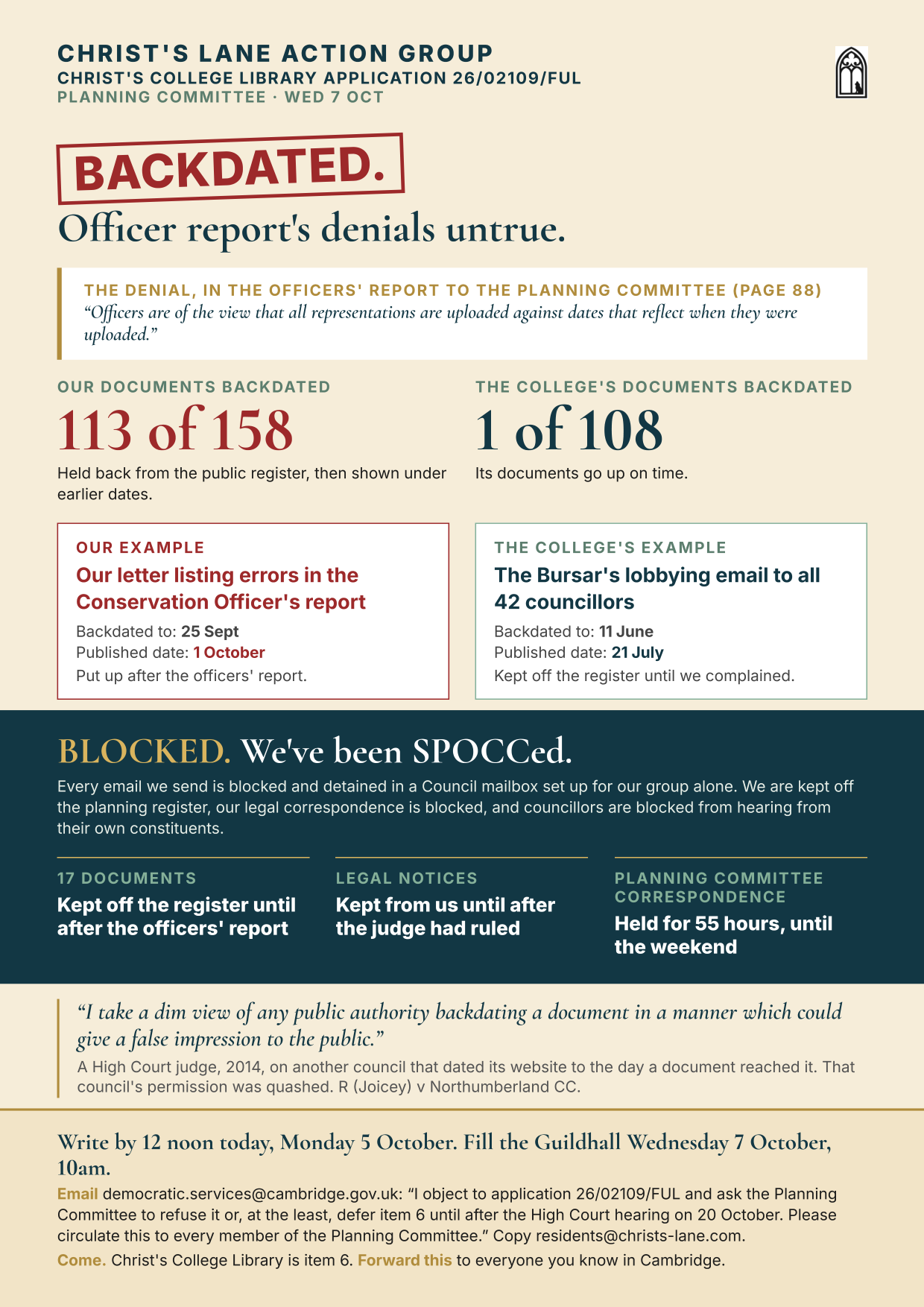
Residents have been blocked and backdated by Cambridge Council
The Council has admitted to the High Court that its committee was misled. On Wednesday it asks the same committee to approve the same building, after blocking our emails to councillors and backdating our evidence.
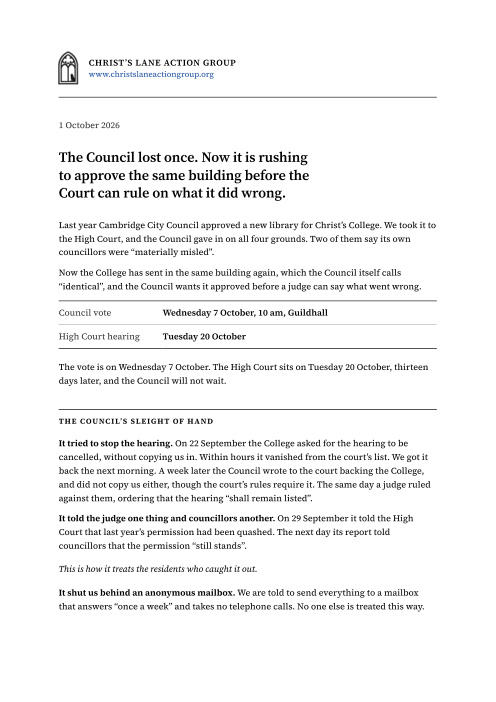
The Council lost once. Now it is rushing to approve the same building
The October newsletter: the Council gave in on all four grounds, and now wants the identical building approved before a judge can say what went wrong.
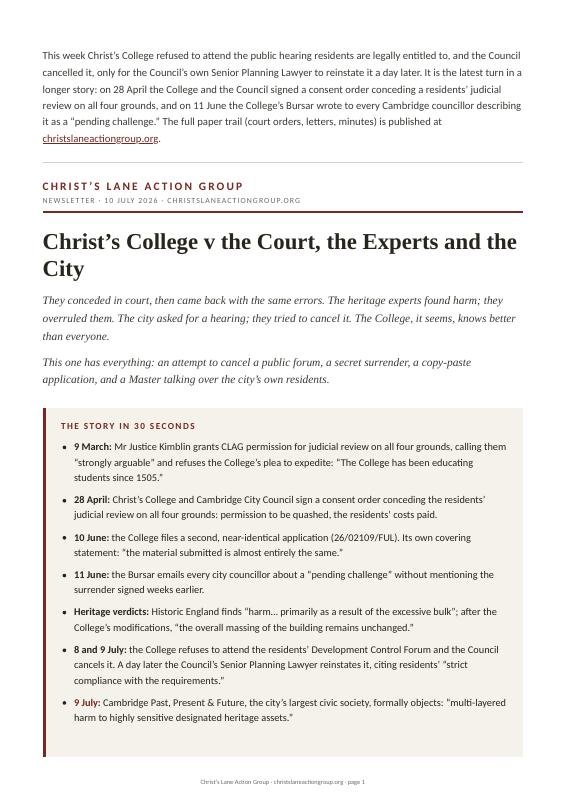
Christ’s College v the Court, the Experts and the City
The July newsletter: a secret surrender, a copy-paste application, an attempt to cancel a public forum, and a Master talking over the city’s own residents.