
The hearing
On Tuesday 20 October 2026 the High Court quashed the first permission, 25/02161/FUL, on all four grounds of our claim, in R (Christ's Lane Action Group) v Cambridge City Council, AC-2025-LON-004656, before Mr Justice Kolinsky in the Planning Court.
The case is R (Christ’s Lane Action Group) v Cambridge City Council, Christ’s College Cambridge interested party, AC-2025-LON-004656, in the Planning Court. It challenged the Council’s permission of 7 November 2025 for a four storey library on Christ’s Lane beside the Grade I listed Bodley Library, application 25/02161/FUL. Christ’s Lane Action Group is represented by Emma Dring of Cornerstone Barristers.
What the Court decided
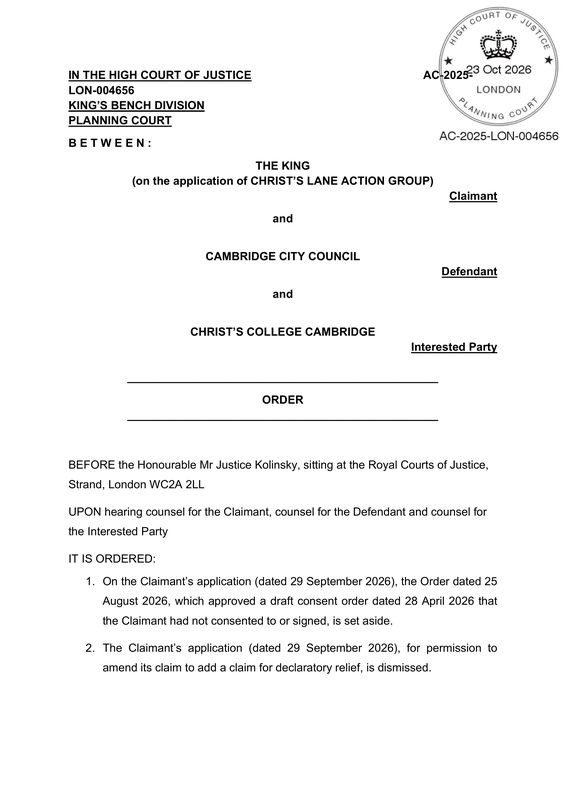
On Tuesday 20 October 2026 Mr Justice Kolinsky set aside, on our application, the Court’s order of 25 August 2026, which had approved a draft consent order we had not signed. He quashed the Council’s permission of 7 November 2025 (25/02161/FUL) on each of the four grounds of our claim, and recorded ‘errors of approach on each of the grounds’.
The judgment was given orally in open court on Tuesday 20 October. The sealed Court order is below. The official transcript of the judgment will be made available here.
How the case reached the hearing
18 December 2025. The claim is filed on four grounds.
6 March 2026. Mr Justice Kimblin grants permission on all four grounds. His order says: “The Claimant raises important issues about the decision making in this case which had a bearing on key planning considerations which informed the grant of consent. I consider that they are strongly arguable and merit consideration at a full hearing.” He refuses the College’s request for an early hearing: “the College chose to enter contracts before the permission was legally secure. That was a risk which it chose to take. The College has been educating students since 1505. If it takes some additional time to review the legality of the consent, that is something which the College will manage.” He orders that the case “is NOT suitable for hearing by a Deputy High Court Judge”. The order is served on 9 March 2026.
28 April 2026. The Council’s letter to the Court says: “It is acknowledged that there is no agreed final order before the Court, since the Claimant has refused to sign the Consent Order attached”. We do not sign. We ask the Court for a reasoned judgment on the grounds.
28 May 2026. The hearing is listed for Tuesday 20 October 2026 before a High Court Judge, one day.
1 June 2026. The Council writes to the Court again, asking it to make a final order in the draft’s terms of its own motion, or else to list a short hearing of ninety minutes at the earliest date.
8 June 2026. The Council sends the Court its statement of matters. Paragraph 12: “Having reviewed its position following the grant of permission, the Defendant accepts that the Decision Notice should be quashed on the basis of the Grounds above.” Paragraph 13 states that the Claimant and the Interested Party “have signed the draft Consent Order”. We had not, and told the Court so the same day.
10 June 2026. The College submits the identical scheme again as application 26/02109/FUL. The College’s covering statement says the second application was made “Rather than wait for the application to be referred back to the Council by the High Court”.
28 July 2026. The Council’s senior planning lawyer writes that the application is “targeted to be put before planning committee on the 2 September, whether or not the High Court has issued a decision”. On 26 August the Council writes that the application will go to committee “whether that falls before the 20 October or not”.
25 and 26 August 2026. An order in the draft’s terms is approved on the papers and served on the Council’s and the College’s solicitors and on counsel. It recites that the parties “are agreed as to the terms of this Order”. We first see it on 21 September.
8 September 2026. The Court writes: “Please disregard the previously served consent order that was sent on the 26/08/2026 due to administrative error.”
22 September 2026. The College’s solicitors ask the Court “to confirm whether the hearing can be vacated”, writing that “there is no public interest that would be served by the hearing going ahead”. The Court writes the same day that the order of 26 August “was served in error as the claimant had not consented to the terms in the order”.
23 September 2026. We ask that the hearing stay in the list. The College’s solicitors write that the document of 26 August “remains a valid and enforceable order of the Court” and that “The substantive claim is therefore spent”. The List Office: “the hearing remain listed for 20th October 2026 as CO was not signed by Claimant”.
29 September 2026. We apply to the Court to set the document of 26 August aside. Sir Peter Lane orders: “1. The substantive hearing fixed for 1 day on 20 October 2026 shall remain listed. 2. The parties can expect the Court on that day to consider first whether, in the circumstances, it is appropriate to proceed as the Claimant contends.” His reasons: “the most practicable course is to keep the listing for 20 October.” We send the order to the Council the same afternoon. The Council’s senior planning lawyer writes that morning that the Council treats our claim as “still extant”.
7 October 2026. The Council's Planning Committee resolves to approve the identical scheme, 26/02109/FUL. The Council's skeleton argument for the hearing, filed the same week, tells the Court at paragraph 2(1): "There remains a valid Order, endorsed by the Court and dated 26 August 2026, which quashes the decision granting planning permission on all 4 grounds in the claim." The report before members says at paragraph 1.2 that "the Court has not done so" and that "The planning permission still stands until such time as the Court determines otherwise."
In the meeting the Senior Planning Lawyer told members the Council had agreed "a consent order that effectively quashed the planning permission, quashed the decision", and the Chair told them the quashing "isn't a decision yet because it hasn't gone to the court". The Delivery Manager told members the report "does not rely upon the concept of optimum viable use"; the report counts the continued use of the Grade I buildings as a social benefit with "significant weight", the error the Council conceded in this claim and the report repeats. The Chair told members three times that if they deferred the Council "would lose the right to determine this application".
A motion to defer, proposed and seconded, was never put to the vote. The record of the meeting, statement by statement with the time on the webcast, is in the News entries for the day and on The application page.
13 October 2026. The Secretary of State directs the Council not to grant permission on the second application, 26/02109/FUL, without her specific authorisation.
20 October 2026. The Court sets aside, on our application, its order of 25 August 2026, which had approved the draft consent order we had not signed.
20 October 2026. The Court quashes the permission for the first application, 25/02161/FUL, on all four grounds of our claim.
Sources: the order of 6 March 2026 (register document 9462886); the Council’s letter of 28 April 2026 and the draft consent order (document 9462822); the statement of matters (document 9540128); the College’s covering statement (document 9423967, paragraph 2.2); the Council’s letter of 28 July 2026 (document 9495878); the Court correspondence of 8, 22 and 23 September 2026; the order of 29 September 2026 (Appendix 1 to the Amendment Sheet; document 9541595); the Council’s skeleton argument; the officer’s report, paragraph 1.2; the direction (document 9554694).
Four grounds. What members were told, and what the documents said.
The four grounds in short are in the Court case block on the home page: each in the claim's words, the 2025 report's sentence beside the document it misstated, and the 2026 report's repeat. The full record of each is on the Documents page. Read the four grounds in full
The documents
The Statement of Facts and Grounds, 18 December 2025. The claim, settled by counsel: the facts, the four grounds, the authorities.
The order of Mr Justice Kimblin, signed 6 March and served 9 March 2026. Permission on all four grounds; expedition refused; the case not suitable for a Deputy High Court Judge.
The draft consent order of 28 April 2026 with the Council’s covering letter. Signed by the Council and the College only.
The Council’s statement of matters, sent to the Court on 8 June 2026. The Council accepts that the decision notice should be quashed on the four grounds.
The hearing listing of 28 May 2026. One day, in person, before a High Court Judge.
The order of Sir Peter Lane of 29 September 2026, with the Court correspondence of 8, 22, 23 and 29 September 2026.
Support the Secretary of State call-in
The Secretary of State is deciding whether to call application 26/02109/FUL in. We need you to write to her in support of a call in. If you would like to, write to us at residents@christs-lane.com and we will tell you how.
The first permission is quashed. The second is frozen.
On Tuesday 20 October 2026 the High Court quashed the first approval, 25/02161/FUL, on all four grounds of our claim. The Secretary of State has frozen the permission. On 13 October she directed the Council not to grant it without her authorisation while she considers whether to call the application in, six days after the identical application 26/02109/FUL was controversially approved. If you would like to support a call in, write to us and we will tell you how.
Email residents@christs-lane.com.