
The Fact Check
The Christ’s College Library+ dispute: what the documents show
Judicial review AC-2025-LON-004656 · Application 26/02109/FUL · Updated 11 July 2026
One fact check, and one correction. The fact check sets the College’s public statements about the judicial review against the court papers, with every source document in full text. Below it: after CLAG fact-checked The Observer’s architecture column of 5 July 2026, the article was corrected online. The corrected paragraph and the correction note are reprinted in full.
Prepared from primary court and planning documents only · All quotations verbatim
Fact check
College’s JR Claims Fact Check
The College has told councillors the judicial review was about process, not the building. Set beside the court papers, all four grounds, on which the High Court quashed the permission, concern heritage harm and the design’s impact on Grade I listed buildings. The College repeated the claim at its 6 July open meeting.
Read the full fact checkClose this fact checkBriefing · Christ’s College Library+ · Planning Court AC-2025-LON-004656
The court papers show that the judicial review was a legal challenge to the lawfulness of Cambridge City Council’s decision-making. But the legal errors the Council and the College accepted were not abstract procedural points: all four concerned how the proposed building’s heritage impacts were assessed, described, weighed and evidenced.
In summaryJudicial review is not a planning merits appeal, and the College is right that the court would not redesign the library or substitute its own planning judgment. The documents below show, however, that the four grounds, granted permission by Mr Justice Kimblin, then accepted by Cambridge City Council and Christ’s College as grounds for quashing the permission, all concerned heritage harm and the assessment of the proposed building’s design impacts on Grade I listed buildings and the conservation area. Readers can judge for themselves whether “about process, not the building” is a complete description.
What this page does not say
This page does not say that the court was being asked to redesign the library, choose between architectural styles, or decide whether the scheme deserves planning permission. Judicial review tests whether a decision-maker made a legal error; it does not conduct a fresh planning assessment.
It does say that the legal errors accepted in this case were inseparable from the proposed building’s heritage effects: Historic England’s advice on massing and bulk, the existence and weight of heritage harm, the public-benefits balance, optimum viable use, and alternative designs.
Public statement 1
The Bursar’s email to councillors, 11 June 2026
“The details of the project have not changed, as the Judicial Review relates to the Council’s decision-making process, not the details of the College’s project.”
The Bursar, Christ’s College Cambridge, in an email to all 42 Cambridge City Councillors, 11 June 2026.
“As the Judicial Review relates to the process involved in determining the original application, not the planning merits, the material submitted is almost entirely the same as for 25/02161/FUL.”
Christ’s College Library Project, Second Planning Application Covering Statement, para 1.5 (Turley for Christ’s College, June 2026).
“The heritage case hasn’t changed.” … “The judicial review is not against Christ’s College. The judicial review is against the city of Cambridge.”
The Master, Christ’s College open meeting, 6 July 2026 (CLAG record).
Relevant documents
The four grounds of challenge
The Statement of Facts and Grounds stated that the planning committee’s decision was legally flawed “in the way it dealt with heritage matters” and that the statutory duty under section 66(1) of the Planning (Listed Buildings and Conservation Areas) Act 1990 was not lawfully discharged. The four grounds (paragraph 6) alleged, in summary:
- Ground 1The committee was materially misled about Historic England’s advice: Historic England had identified harm from the bulk and overall massing of the proposal, that massing remained “unchanged” after amendments, and that finding was omitted from the officer’s report.
- Ground 2The committee received inconsistent advice on whether there was less than substantial harm requiring a public-benefits balance under NPPF paragraph 215, or a neutral impact meaning no harm. The report did both simultaneously, risking dilution of the mandatory weight to be given to harm.
- Ground 3The committee was advised that the scheme would help to secure the listed building’s “optimum viable use” as a public benefit. That was based on flawed logic and was unsupported by evidence: the college has been in continuous educational use for over 500 years.
- Ground 4Where harm to a listed building’s setting is identified, consideration of less harmful alternatives is a material consideration. The committee was not advised of this, even though alternatives existed.
Those are legal grounds. But they are legal grounds about heritage harm, massing, the officer’s summary of Historic England’s advice, the public-benefits balance, and whether a less harmful design should have been considered, all matters inseparable from the details of the proposed building.
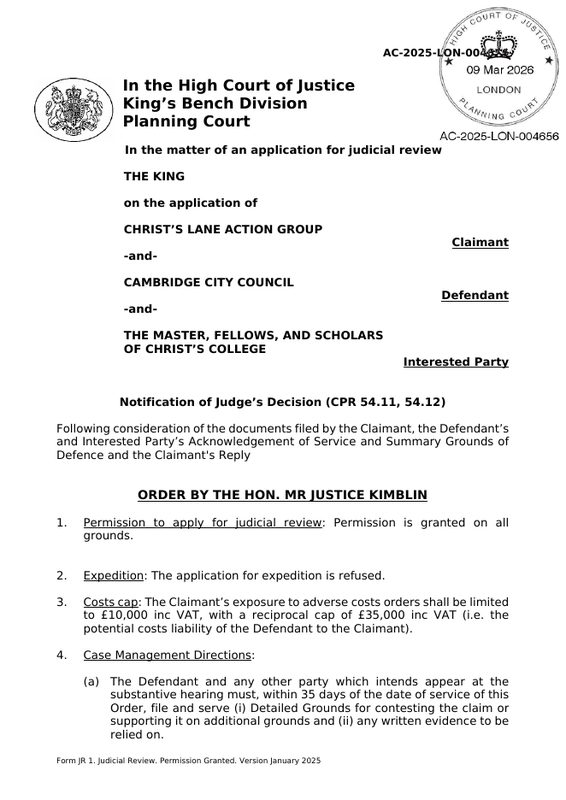
Mr Justice Kimblin granted permission on all grounds
“Permission to apply for judicial review: Permission is granted on all grounds.”Order by Mr Justice Kimblin, 6 March 2026 (served 9 March 2026).
“The Claimant raises important issues about the decision making in this case which had a bearing on key planning considerations which informed the grant of consent. I consider that they are strongly arguable and merit consideration at a full hearing.”Mr Justice Kimblin, Observations and Reasons, 6 March 2026.
Cambridge City Council and Christ’s College then agreed, by consent order, that the permission could be quashed on all four grounds
“The Defendant and Interested Party have agreed to a Consent Order quashing the Council’s decision on all four grounds, with a supporting Statement.”Cambridge City Council letter to the Administrative Court, 28 April 2026, para 6.
Historic England’s advice identified harm from the design
“The resulting increased massing brings other instances of harm, as it puts considerable pressure on the surrounding buildings forming Bath Court. The building feels too big, overdominant on this space, particularly in its relationship with the south range of first court and the Bodley Library.”Historic England first consultation response, 29 July 2025.
“To summarise and conclude, in their present form, the proposals would result in certain levels of harm to the significance of the listed building, primarily as a result of the excessive bulk of the new building, which we consider would detract from the setting of the surrounding buildings.”Historic England first consultation response, 29 July 2025.
“The overall massing of the building remains unchanged.”Historic England second consultation response, 1 September 2025.
These are comments about the design, its scale, bulk, massing and relationship with Grade I listed buildings. If the judicial review truly had nothing to do with those matters, Ground 1 (which alleged the report misrepresented Historic England’s advice about the design) would not exist.
Comparison
Judicial review tests legal error, not architectural merit, and in that narrow sense both statements are defensible. “Planning merits” is defensible in the same narrow way: the court will not substitute its own planning judgment. But the four grounds pleaded in the Statement of Facts and Grounds, quoted above, all turn on the heritage assessment of the building’s design. In CLAG’s view, “not the details of the College’s project” and “almost entirely the same as for 25/02161/FUL” should be read alongside those grounds, which concern the building directly. The College’s own Covering Statement for the second application, 26/02109/FUL, quoted above, reopens the heritage balance and argues the case for heritage benefit rather than heritage harm. The claim did not survive the College’s own open meeting unchallenged: asked from the floor “If it’s not against you, why did you sign it? We have your signature”, the Master moved the meeting on.
Public statement 2
The second application’s Covering Statement, paragraph 3.17
“A high-quality scheme, which evolved through a year of pre-application discussions with the Council and Historic England, was supported by all professional consultees, and ultimately approved by Planning Committee has been significantly slowed down.”
Covering Statement, para 3.17 (Turley for Christ’s College, June 2026).
“The bottom line for every single consultee was no objection.”
The Master, Christ’s College open meeting, 6 July 2026 (CLAG record).
Relevant documents
What Historic England actually said
Historic England is a statutory consultee under the Arrangements for Handling Heritage Applications Direction 2021. Its first consultation letter did not support the scheme; it identified harm and called for massing to be reduced:
“We are of the view that the building is too big for its location.”Historic England first consultation response, 29 July 2025.
“We do not wish to object to the application but would strongly encourage that massing is further reduced so it sits better within this context.”Historic England first consultation response, 29 July 2025.
After amendments were submitted in August 2025, Historic England’s second letter welcomed chimney revisions but confirmed the core concern was unresolved:
“The overall massing of the building remains unchanged.”Historic England second consultation response, 1 September 2025.
Ground 1 of the judicial review, one of the four grounds on which the High Court quashed the permission, alleged that the officer’s report materially misled the committee about this advice, omitting Historic England’s finding of harm from excessive bulk and its call for reduced massing.
What the Victorian Society actually said
The Victorian Society is one of the national amenity societies consulted on applications affecting listed buildings. Its response of 22 August 2025 welcomed the principle of a new library and appreciated the architectural quality, but raised material concerns about harm to the Grade I Bodley Library:
“Although the 2016 scheme would not be overtly harmful to the Grade-I Listed Heritage Asset, as the newly proposed scheme has the potential to be…”The Victorian Society consultation response, 22 August 2025.
“It would not be unreasonable for the scale of the proposed to take its lead from the floor heights of the Bodley, opting to align the floors with the oriel window of the Bodley structure, thus reducing the height by approximately half at each floor.”The Victorian Society consultation response, 22 August 2025.
“At present, the proposed appears to lack the human scale evocative both in the Bodley Library and the C15 first court.”The Victorian Society consultation response, 22 August 2025.
The distinction that matters
| What the College said | What the documents show |
|---|---|
| “Supported by all professional consultees” | Historic England identified harm from excessive bulk, called the building “too big for its location”, and strongly encouraged reduced massing. It did not object, but it did not support the scheme as submitted. |
| “Supported by all professional consultees” | The Victorian Society said the 2016 scheme was not harmful but the new scheme “has the potential to be” harmful. It recommended reducing height by approximately half at each floor. It did not formally object. |
A more complete statement would be: “No statutory consultee maintained a formal objection, but Historic England and the Victorian Society raised material concerns about bulk, massing, scale and heritage harm.”
Comparison
“No objection” is not the same as support. Both Historic England and the Victorian Society, quoted above, raised material heritage concerns and asked for the massing to be reduced. CLAG’s view is that “supported by all professional consultees” does not reflect what those consultees actually wrote.
Public statement 3
The Bursar’s email to councillors, 11 June 2026
“The High Court is not due to hear that Judicial Review until 20 October 2026, 12 months after planning permission was granted.”
The Bursar, Christ’s College Cambridge, in an email to all 42 Cambridge City Councillors, 11 June 2026.
Relevant documents
What the email omits
The Bursar’s email of 11 June 2026 presents the judicial review as a future hearing causing delay. It does not mention that six weeks earlier, on 28 April 2026, Cambridge City Council had written to the Planning Court enclosing a consent order signed by both the Council and Christ’s College, asking the court to make a final order quashing the permission:
“The Defendant and Interested Party have agreed to a Consent Order quashing the Council’s decision on all four grounds relied upon by the Claimant.”Cambridge City Council letter to the Administrative Court, 28 April 2026, para 6.
“In the unusual circumstances of this case, where both the Defendant and Interested Party agree that the grant of planning permission can be quashed on all grounds relied upon by the Claimant, we invite the Court of its own motion to make a final order in the same terms as the Consent Order.”Cambridge City Council letter to the Administrative Court, 28 April 2026, para 10.
Kimblin J also noted in his permission decision that “the College chose to enter contracts before the permission was legally secure. That was a risk which it chose to take.” The email to councillors, which sought to explain why a second application, 26/02109/FUL, was being submitted, did not mention that both the Council and College had already agreed the first permission could be quashed on all four grounds. The omission persisted until the College’s open meeting of 6 July 2026, where the consent order was put on the record from the floor; a senior academic noted the signed concession “has not been communicated to the public” (CLAG record).
Why the hearing went ahead
For completeness: the Claimant did not sign the consent order. The Claimant did not agree to a quashing by consent and asked the court to determine the claim at a substantive hearing, so that the legal errors are resolved in a reasoned, published judgment rather than by a negotiated order. That is why the 20 October 2026 hearing referred to in the email went ahead. The hearing took place in Court 18 at the Royal Courts of Justice, before Mr Justice Kolinsky, in R (Christ's Lane Action Group) v Cambridge City Council, AC-2025-LON-004656, in the Planning Court. The issue identified here is not that the hearing was unnecessary, it went ahead, but that the email described it as a future delay without disclosing that the Council and the College had already accepted, in writing to the court, that the permission could be quashed on all four grounds.
The hearing date is confirmed in writing by the court: on 28 May 2026 the Administrative Court List Office listed the substantive hearing for 20 October 2026, with a one-day time estimate, in person at the Royal Courts of Justice. Read the List Office confirmation.
Comparison
The hearing date is correct. But by the time of the email the Council and Christ’s College had already signed and submitted a consent order agreeing the permission could be quashed on all four grounds; the Claimant declined to consent so that the court would give a reasoned judgment, which is why the hearing went ahead (see above). In CLAG’s assessment, the statement omits that material context.
Correction
The Observer, Corrected
After CLAG fact-checked The Observer’s architecture column of 5 July 2026, the article was corrected online. The consent order, the quashing, the costs and the live second application, 26/02109/FUL, are now on the record in the article itself. The corrected paragraph and the correction note are reprinted in full.
Read the correctionClose this correctionThe corrected paragraph, in full
“The group has taken the college to court, along with Cambridge city council, which granted permission last autumn. Clag has won the first round of its case, with the college and council signing a consent order in April agreeing to quash the permission and pay the group’s costs. Clag has not signed, pending a judicial review. A second application has now been submitted, and is currently the subject of consultation.”
Rowan Moore, The Observer, 5 July 2026; corrected online edition.
On 5 July 2026 The Observer published its architecture column on the Christ’s Lane scheme. CLAG published a fact check the same week, setting five of the column’s factual statements beside the court orders and consultation responses they refer to. The Observer has since corrected the article online: the paragraph above now stands in the article in place of the original account of the legal position.
And at the foot of the article:
“This article has been changed since publication to clarify the current legal and planning situation and to add the word ‘significantly’ to the reference to overshadowing.”Correction note, The Observer.
The consent order, the quashing, the costs and the live second application, 26/02109/FUL: each is now on the record in the article itself. The original fact check is preserved unchanged in the archive.
Read the corrected article Read the archived fact checkSource documents
Every quotation on this page is from one of these primary documents, each linked to its full text on this site.
- Bursar’s email to Cambridge City Councillors, 11 June 2026 (Office of the Bursar, Christ’s College).
- Christ’s College Library Project, Second Planning Application Covering Statement, June 2026 (Turley for Christ’s College, application 26/02109/FUL).
- Statement of Facts and Grounds, Planning Court case AC-2025-LON-004656 (filed December 2025).
- Order by Mr Justice Kimblin granting permission on all grounds, signed 6 March 2026 (served 9 March 2026).
- Consent Order signed by Cambridge City Council and Christ’s College, 28 April 2026, with the Council’s covering letter to the Administrative Court (Vanessa Blane, 3C Shared Services Legal).
- Administrative Court List Office confirmation that the substantive hearing is listed for 20 October 2026 (email of 28 May 2026, one-day time estimate, Royal Courts of Justice).
- Historic England first consultation response, 29 July 2025 (Rosa Teira Paz, Inspector of Historic Buildings and Areas).
- Historic England second consultation response, 1 September 2025.
- Victorian Society consultation response, 22 August 2025.
- Alec Forshaw IHBC MRTPI independent heritage appraisal, October 2025.
- Victorian Society consultation response on the resubmitted scheme, 6 July 2026 (application 26/02109/FUL).
- Cambridge Past, Present & Future objection, 9 July 2026 (application 26/02109/FUL).
- Alec Forshaw IHBC MRTPI updated heritage appraisal, July 2026 (application 26/02109/FUL, incorporating his October 2025 appraisal in full).
- eb7 Ltd independent daylight, sunlight and overshadowing review, 16 October 2025 (specialist daylight consultancy instructed by CLAG).
Methodology
Each comparison above quotes one public statement, then the document or documents it refers to, so the two can be read side by side. All quotations are verbatim and the source documents are listed above. Nothing is paraphrased as evidence. Where a sentence is introduced as CLAG’s view, it is our reading of those documents, offered as opinion rather than as a finding of fact.
Corrections and right of reply
If Christ’s College, Cambridge City Council, Historic England, the Victorian Society, The Observer, Rowan Moore, or any named author of a source document believes this page misquotes or mischaracterises a document, please email residents@christs-lane.com with the relevant passage and the correction sought. Any response received will be published here in full.
Any correction will be recorded on this page with the date of amendment. Substantive written responses will be linked from this page if provided.
This page is an explainer. It sets public statements next to the primary documents they refer to so that readers can compare them. Quotations are reproduced verbatim; any conclusion drawn by CLAG is identified as CLAG’s view and rests on the documents quoted.
Prepared by Christ’s Lane Action Group from primary documents only. No secondary sources, and no opinions from CLAG members, are used as evidence. All quotations are verbatim from the documents cited. This page should be read with the source documents linked above.
Every document in full text
Each document below has its own page with the full text, so it can be read, searched and quoted directly, with the original PDF linked from every page.
Judicial Review
 PDF · 4 pages
Court Order: Permission for Hearing
Order of Mr Justice Kimblin granting permission on all four grounds at the paper stage.
Read the full text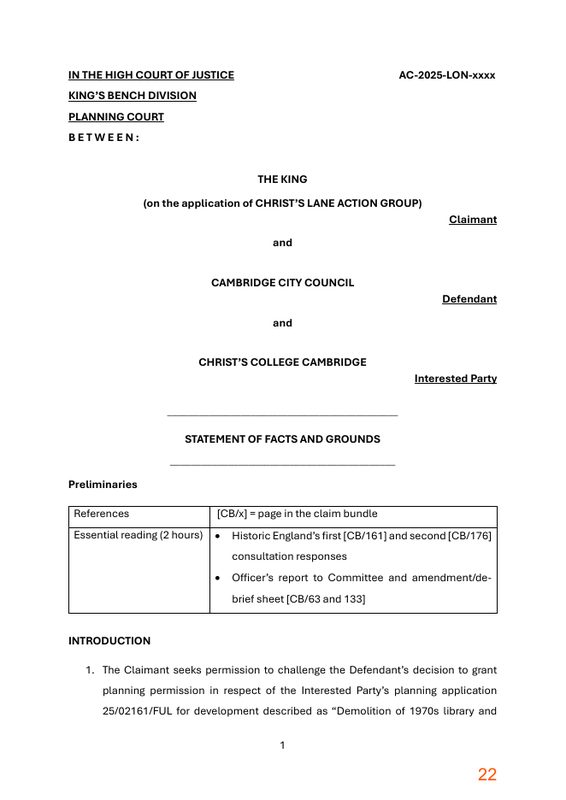 PDF · 36 pages
Judicial Review Facts and Grounds
The claim bundle filed in the High Court, Planning Court by Christ’s Lane Action Group, represented by Emma Dring of Cornerstone Barristers.
Read the full text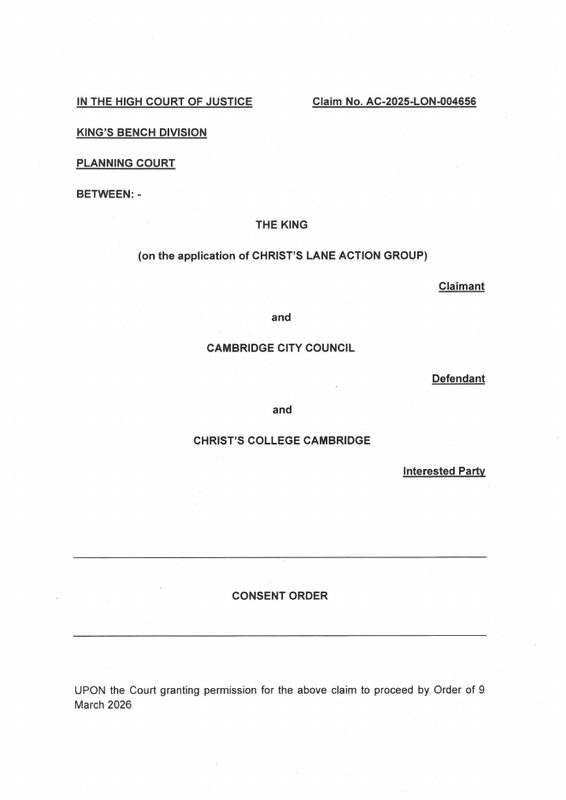 PDF · 6 pages
Consent Order signed by the College and the Council, with the Council’s covering letter
Signed by the Defendant (Cambridge City Council) and Interested Party (Christ’s College) on 28 April 2026, agreeing the 7 November 2025 planning permission should be quashed on all four grounds, with the Council’s covering letter inviting the court to make a final order in those terms.
Read the full text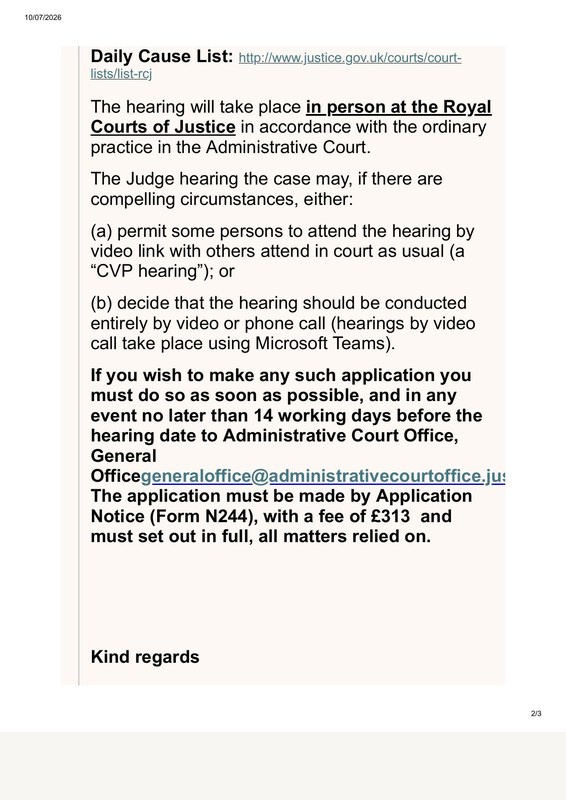 PDF · 3 pages
Substantive Hearing Listed: 20 October 2026
The Administrative Court List Office confirms the substantive hearing is listed for 20 October 2026, with a one-day time estimate, in person at the Royal Courts of Justice.
Read the full textThe Second Application
 PDF · 12 pages
The Statement That Calls Harm a Benefit
The College’s June 2026 covering statement for the second application (26/02109/FUL), in which the heritage harm identified in the first application, 25/02161/FUL, is recast as a public benefit.
Read the full text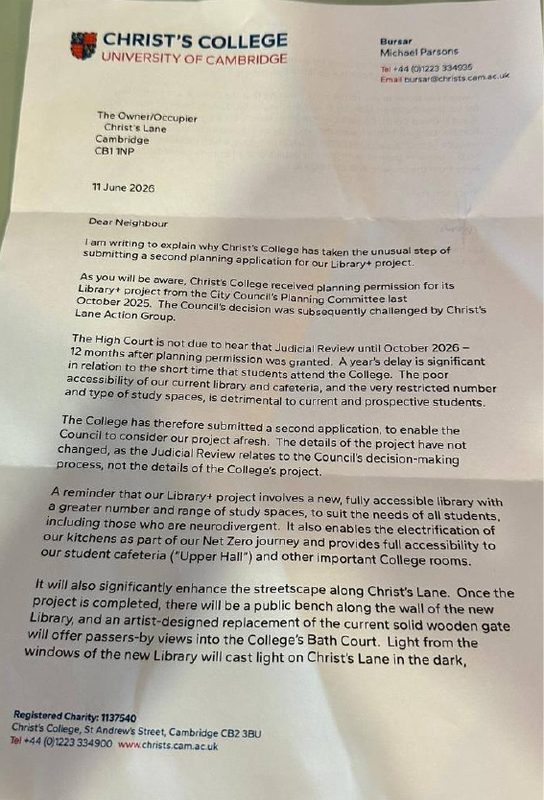 PDF · 2 pages
The Bursar’s Email and the Consent to Quash It Kept Very Quiet
In this email to all 42 city councillors, the Bursar assures them nothing has changed, omitting a material fact: the College had just signed a draft consent order agreeing that the first permission should be quashed on all four grounds.
Read the full text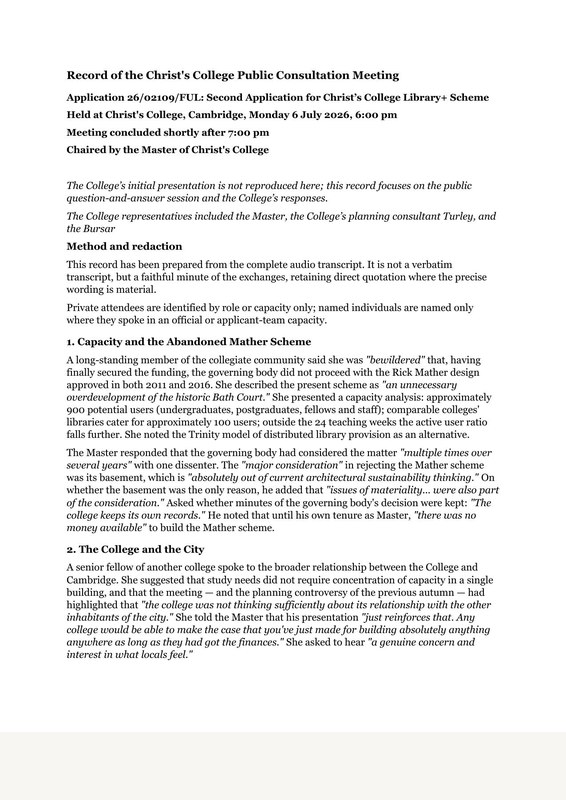 PDF · 5 pages
The Open Meeting Where the Master Faced the City
CLAG’s record of the College’s 6 July open meeting: the abandoned Mather scheme, the admission that under paragraph 3.16 public benefits “do not need to be provided”, the Victorian Society dismissed as “one of the 22”, and a resident told “I am now going to talk over you deliberately.”
Read the full textHeritage Appraisal
 PDF · 5 pages
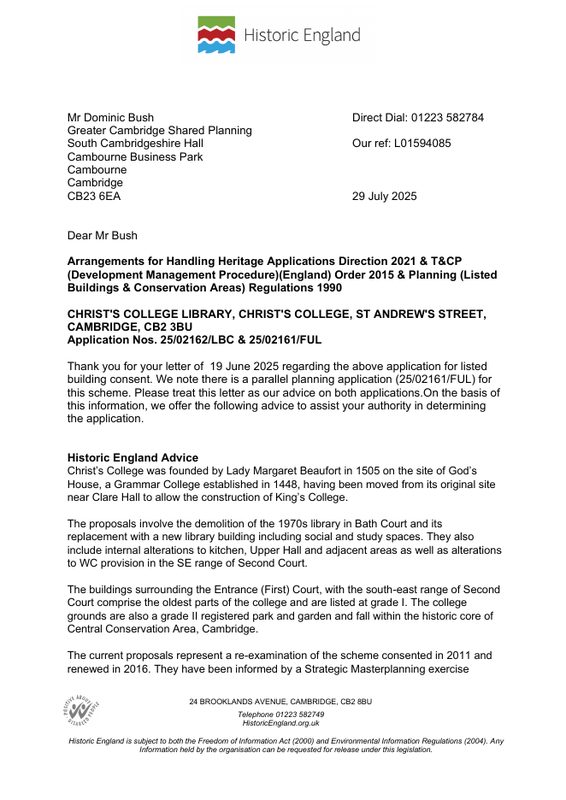
Historic England: First Advice (25/02161/FUL)
Historic England’s substantive advice: the proposed building is too large for its Grade I listed setting and would cause harm through excessive bulk.
Read the full text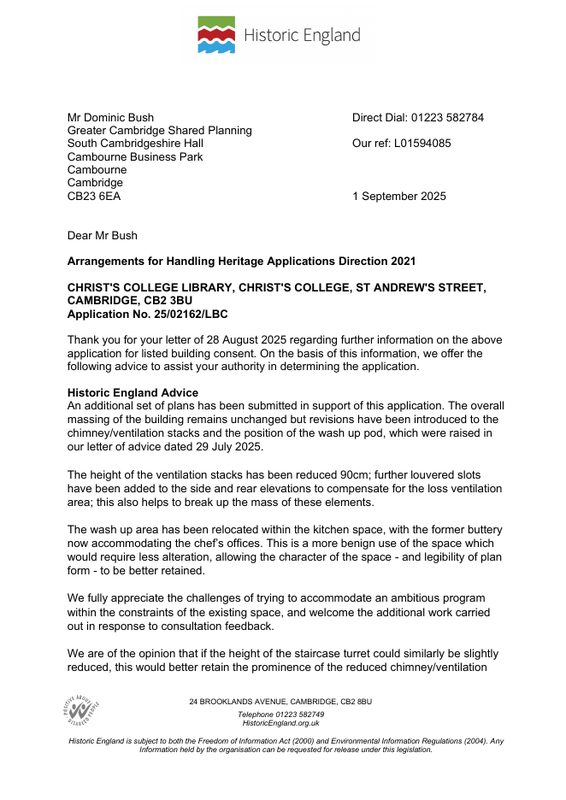 PDF · 2 pages
Historic England: Second Advice (25/02161/FUL)
Historic England looked again and held the line: the excessive bulk remained, and so did the harm.
Read the full text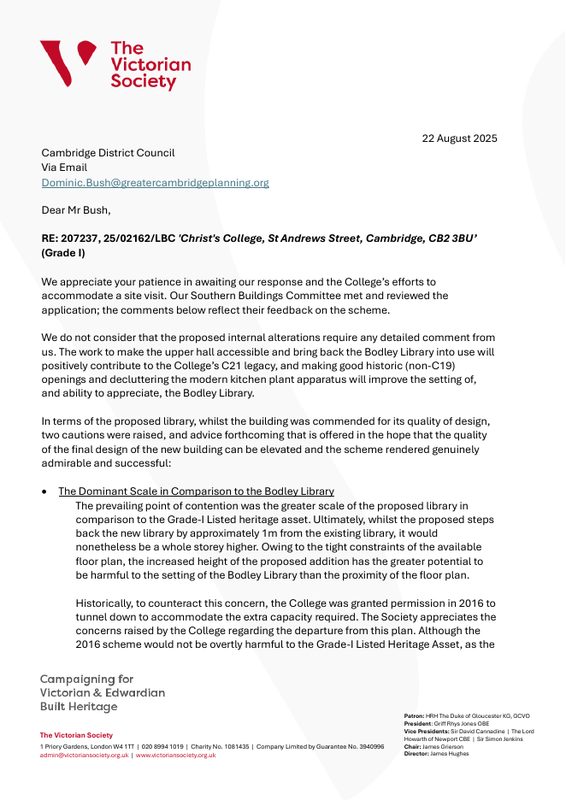 PDF · 3 pages
The Victorian Society (25/02162/LBC)
The Victorian Society’s remedy is blunt: halve the height. Align each floor with Bodley’s oriel window, drop the brutalist styling, and the new library could finally answer the building beside it.
Read the full text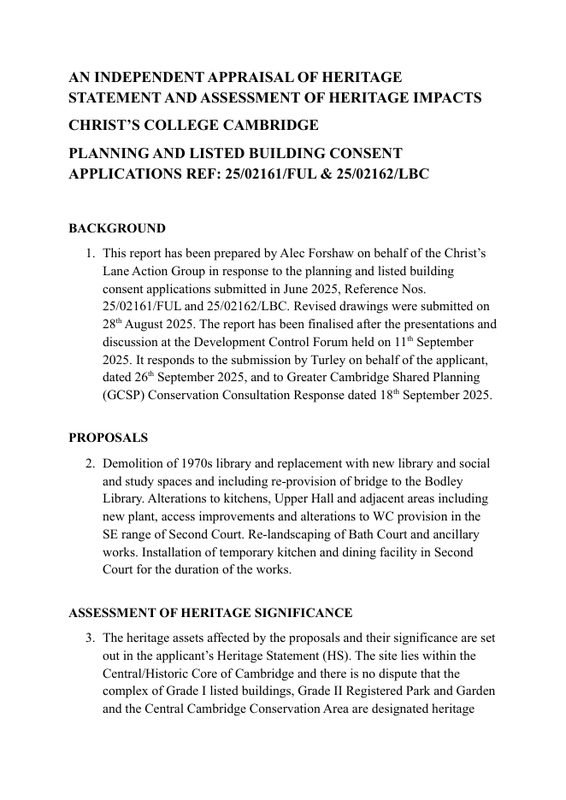 PDF · 20 pages
Alec Forshaw: Heritage Appraisal (25/02161/FUL)
An independent expert’s verdict in full: too big, over-dominant, and set to swallow the clear-sky views of Bodley’s gable and turret that make the lane what it is.
Read the full text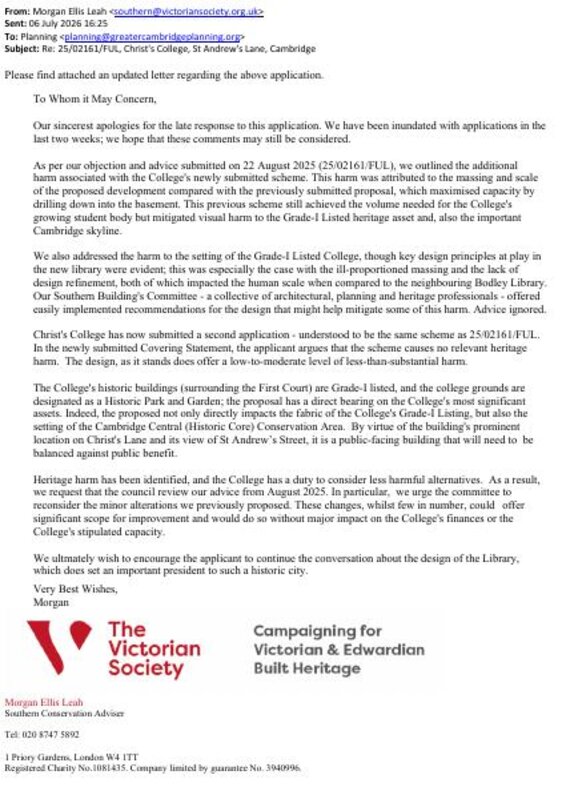 PDF · 3 pages
The Victorian Society (26/02109/FUL)
Responding to the resubmitted scheme, 26/02109/FUL, the Society maintained its objection: the design still offers a low-to-moderate level of less-than-substantial harm, and the same submitted scheme cannot improve its level of harm.
Read the full text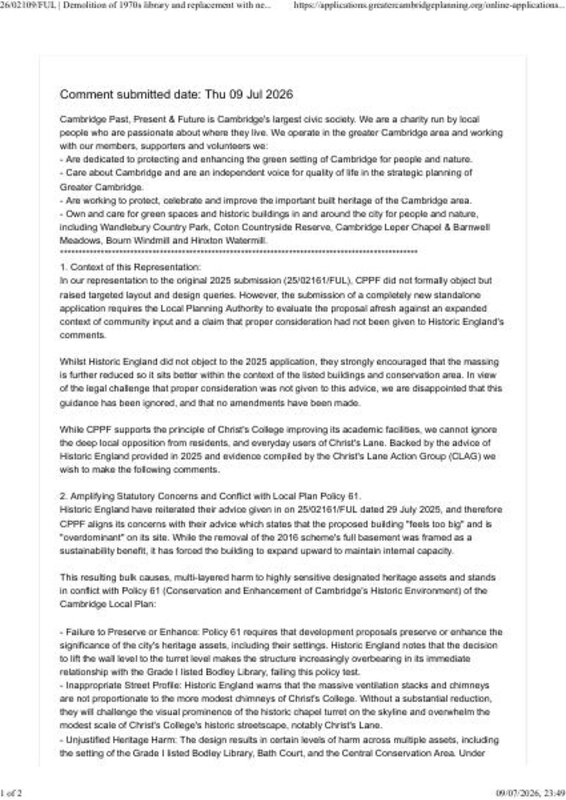 PDF · 2 pages
Cambridge Past, Present & Future (26/02109/FUL)
Cambridge Past, Present & Future objected to the resubmitted scheme, 26/02109/FUL, finding multi-layered harm to highly sensitive designated heritage assets and urging a lower, less bulky design.
Read the full text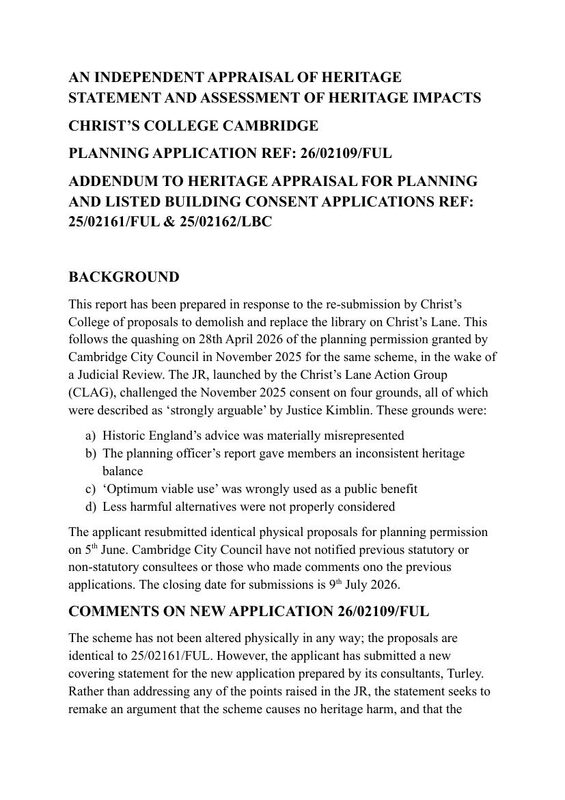 PDF · 23 pages
Alec Forshaw: Heritage Appraisal (26/02109/FUL)
The College’s own conservation specialist refutes the claim of no heritage harm in the resubmission, 26/02109/FUL, and his full October 2025 appraisal, reproduced in full, finds less-than-substantial harm not outweighed by public benefits.
Read the full text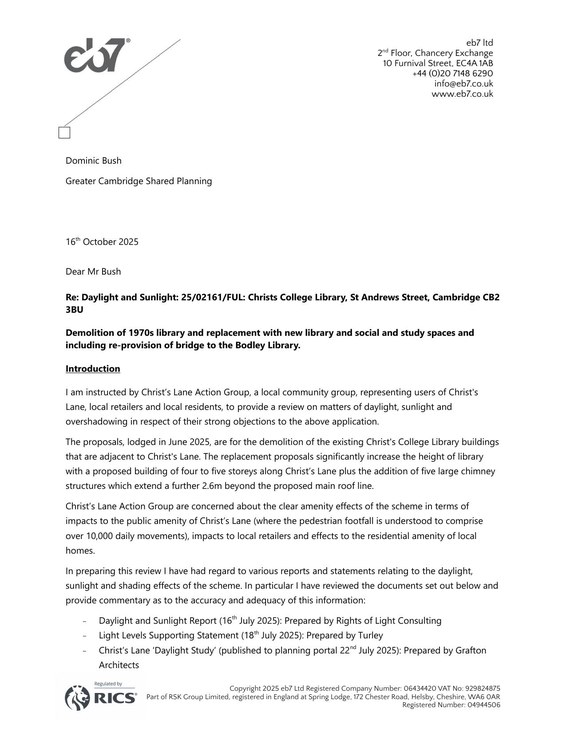 PDF · 9 pages
The first permission is quashed. The second is frozen.
On Tuesday 20 October 2026 the High Court quashed the first approval, 25/02161/FUL, on all four grounds of our claim. The Secretary of State has frozen the permission. On 13 October she directed the Council not to grant it without her authorisation while she considers whether to call the application in, six days after the identical application 26/02109/FUL was controversially approved. If you would like to support a call in, write to us and we will tell you how.
Email residents@christs-lane.com.